Tuesday, March 22, 2016

Sunday, March 6, 2016

Reflection on Trading


Reflection when Directional Bias Scalping / Swinger 

It has been a while since I do reflection post. I believe that a trader grow from reflection and through reflections, they will understand themselves better. I'm back to FX and have been trading very small TF recently and using options to play the longer TF. So far so good! close to 90% winning rate! But I got to be on my toes as I always fk it up when I become profitable and decided to risk more. I aim to average about 85 winning%. I know a huge loss will definitely screw me up and it will happen and almost happen today!!! 

Some reflection when using the new methodology.(Scalping with a directional bias for short term and options for long term) 

Image result for reflection 

1) What differentiates a successful trader and one that is not successful? To have green pips everyday!!!! I looked back my old account when the pips are positive but the account value are negative? WHY? Because I overleverage and wasn't consistent on my lots size. While you maybe consistent on your products, a margin of error wouldn't have hurt you that much unless you decide to over-leverage or trade something that is more than your usual trading size!! How many times have this happened? I busted 2 FX accounts and both are green in pips. I could still remember the trauma when these huge losses are incurred as it affected me and my confidence in trading. Putting the losses of the trade aside, I would have been in a much control position if I have stick to my trading plan/size. Thus, in 2016, I will be using the same lot size every time!!! without fail! I Promise!! I believe this is my greatest hurdle - Risk management. 

2)Understanding the products that really suit them or even the behavior ofFX pairing that will suit the trader's personality the most. You will need to find different products to suit your personality. I dare to say most people are not patience with trading, they want to see instant result. However, if you are patience, use different products to your advantage. I came to realize that I am not the patient trader and in 2016, I am going to use option to trade long term targets for FX. When I mean long term I mean up to a month. Why is that so? Because a option has an expiry. Whether you are doing a spread or buying plain vanilla call or put, there is an expiry which you had already paid the premium for? How many times did you get the trade direction right but you fail to earn any penny from that trade because of margin stop out/stop loss? I believe that all traders have this guilt. These are trades that ought to be minimize. From the first bull spread that I did, I pretty much believe that an option strategy will make the trader mindset more focus and not swayed. You will be tempted to take partial profits/selling and then attempt to buy back at lower prices when you are holding a position. However, by paying the premium upfront, you will have lesser tendency, at least it curbs me. Also, buying premium do not cause margin. THUS, you will be frigging safe from margin stop out and not have to worry about it! 

3)Gambling or trading mindset? In my opinion, a gambler who walks away from the Casino money are either 1) Damn bloody lucky because they fail to lose,2) They simply get out from the Casino when they win money! The longer you stay in the Casino, the higher probability you will turn your winnings into losing. In Chinese, we have a saying called " 10 gamblers, 9 losers". Why do you trade? If it is for the thrill, then you shouldn't be trading. Trading is to make positive profit! There is no enjoyment but a monotonous set of drill that you abide to and then keep your fingers cross. Set a realistic monetary target be it on a daily basis or weekly basis that you want to earn from the market and works towards it. Do not expect to hit a home run. Yes, that trade could be the trade of the year but if you don't take profit and hits your stop loss, who is the stupid one? You have to understand that these perfect trade do not exist (maybe 0.01%, even then, refer to 2 and you shld be using option or stock for it and not marginable products like CFD/FX) This is the reason why now I am trading scalping my FX. Assuming it is a ranging chart, a scalper would have taken profit 2-3 times in an hour before the swing trader is able to take profit the next day. Having said that, if by market forces that the swing trade fall and hit your stop loss then, you would have wasted the opportunity for holding on to that trade for the last few day. When you open a position, and within that hour, 50% of the time, the position moves within X% of your entry, however, 25% of the time, the position will move within 2X% of your entry,12.5% of the time, the position will move 3X% of your entry. Just like a normal distribution graph with the entry @ 0. And if you are spot on in catching the direction of the trade, your trade will naturally spend more time in a positive territory. Then, that is when how greedy/consistent you are to take money from the trade. Easier said than done though. Because every want to hit the trade of the year. However, you need to realize that the probability (Trade of the year) < 0.001. Thus, if you can train yourself to consistently take money off the table, big or small, I think you are on the very right track!

Monday, January 18, 2016

Trading Truths: Trading For A Living

Trading Truths: Trading For A Living

In this weeks trading truths I want to address the realities of trading for a living full time. The internet is full of false promises, of turning your $100 account into a $1,000,00 with a year. Most wannabe traders are attracted to the business by the allure of the opportunity to make life changing sums of money. Others are attracted by the potential freedom trading can provide, with the opportunity to trade form anywhere on the planet as long as you can access a stable internet connection. While the opportunity to create meaningful wealth and a life of liberty is possible, it isn’t going to happen this month or next, like the Forex guru’s would have you believe.

I have been a full time trader for 10 years. During this time I have garnered a substantial amount of experience, while trading for a living certainly has many positives, it isn’t the dream ticket that many are sold. Like any business or career undertaking, the early stages require a HUGE amount of work, just to get off the ground and once you finally defy gravity the hard work doesn’t stop there.

The reality of trading an account for income, is that even once you acquire the knowledge and skill to consistently reap a return from the market, you aren’t going to be doubling your account month on month. You would be a miracle worker to deliver consistent month on month 20% returns. In fact you would be a statistical anomaly. In reality you would be a trading superstar to deliver 10-15% month on month. A more realistic monthly target from my experience is 2-5%. Now obviously there will be outliers in the distribution of your returns, some larger up months accompanied by draw down months. This simple trading truth is one that so many inexperienced traders simply fail to grasp or understand, instead they remain blinded by 200% returns month on month.

So once we accept the reality of the potential percentage gains, we are faced with a harsher reality, we probably wont be able to support ourselves or our families on our $100 trading account. We aren’t going to achieve it on our $1000 account. We are going to struggle on our $10,000 account. Realistically to simply trade for a living covering our expenses and some spending money, we are likely going to need a minimum $50k account, where your 2-5% month will deliver between $1-2,500.

Even once you have adequate capital, you will face further challenges, once your trading account is your sole source of income you will begin to feel the pressure of performance. This is a psychological phenomenon that is difficult to quantify, but it is certainly one that you must consider. If you find your self in the back end of the month trading for your rent check, that pressure is certainly going to impede your decision making capabilities in ways you cant yet imagine. If you extrapolate further and consider the challenge of a draw down month, whereby you have to dip into your trading capital to cover your bills. The following month starts in the hole, you take another few hits, this will put you on the ropes mentally and fiscally. Do you think you have the mental where with all to trade through this type of scenario, suddenly you may experience some shakiness in the trigger finger!

So before you jack in the day job to go it alone and trade for a living, you need to consider the realities of the implications of the decision. So what is the best route to achieving your goal of trading for a living? Well from experience I can tell you there are two key considerations to achieving this goal. First, education resulting in a rigorously back tested trading strategy/plan. Secondly and critically, adequate capitalization. So for those who are truly committed to making a serious career change, I would counsel some soul searching and some conversations with some seasoned individuals, who actually successfully trade for a living, listen carefully to the story of their journey to where they are now. I can guarantee you that behind every story of trading success is a more protracted tale of struggle and self doubt, that had to be hurdled on the road to trading for a living.

Another excellent option for those looking to make the transition to full time trading, especially for those constrained by the capital aspect of the equation, is joining a prop trading programme. Instead of liquidating a smaller account, you would be better investing a sub 10k account directly into yourself and killing two birds with one stone. Through a prop trading programme you can get excellent trading education, with the potential for trading meaningful capital in structured disciplined environment, hence giving yourself the best possible platform for transitioning to trading full time and making a success of your new career/business!

** Extract from FXStreet http://www.fxstreet.com/education/forex-basics/trading-truths-9-trading-for-a-living/2016/01/18/


Tuesday, October 27, 2015

Discretionary and Systematic Trading by Andrea

There are broadly two types of trading: Discretionary and Systematic. Which one should I choose?
Here is the question, maybe the most important question about the approach to dedicate to trading. The question can even be deepened in other kinds of doubts:
  1. What does discretionary actually mean?
  2. What does systematic mean?
As much as I have learned about this I can say that both fields are huge, but there are clear boundaries dividing the two approaches. These clear boundaries are determined by the fact that if at the moment of placing the trade, the trader has to decide whether to place it or not, then he is trading in a discretionary mode.
Regardless of the approach, any market gives us signals to open or close a trade. These signals can come from an automated software previously programmed, from a chart setup drawn by the trader, or even simply by a feeling growing in the stomach of the trader. It doesn’t matter at a certain point a voice inside us is telling us to enter the market. If we can decide whether to listen to this voice or not, then we are discretionary traders.
So, let’s go deeper inside discretionary trading. Three main approaches build this field:
  1. The Video Gamer: Pure instinct based decision
  2. The Chartist: Method built upon observation
  3. The Trigger Puller: Decisions based on the feeling of the moment when an automatic signal is generated
The Video Gamer: The first group is the most aimed for by most of the people. Everybody hopes to be so talented that they can simply sit in front of a monitor, watch quotes going by, understand what should come next and, therefore, make their decisions in what direction to enter the market.
Sitting in front of a monitor and watching prices during the day actually helps in getting a feeling about the moves that take place; but to take a consequent action, and to manage the position going to be opened, is not as easy as it looks.
To be part of this group of traders, a real talent is needed and a very low percentage of people have this gift. Skills can be developed but some special cerebral fuel is needed to perform well in such a style and it is definitively not for everyone.
It would not be bad to use the markets as a video game; but as in video games there are incredibly talented guys and many others who are a real disaster.
We should not forget that as skilled as these players are; considering their usually young age, and youth helps in reaction times, concentration and velocity; getting older, it becomes harder and harder. The same would happen to these instinct based traders.
The Chartist: The second group of discretionary traders usually build a template with indicators or other similar things on which they make their decisions. Sometimes they display a simple moving averages crossover and sometimes they have complicated colored charts with dots and lines moving around everywhere (those are the "decision makers"). These charts are built upon experience and observation and often lead to pretty good results, if the method they are based on is strong. The problem is that it usually takes a long time to arrive to a good development of a decent model, and also a long time to decide if the model is really good. What this approach actually misses is a calculation of the expectation of the strategy. Everything is done by observing and very seldom by a real calculation of "how much" the strategy would have made in the last X years. The employment of a strategy is normally based on a very short period of observation and lacks in robustness and stability for the long haul. A good sensation can be acquainted by observing the behavior of prices over a certain period; but as this is done "manually", the period cannot be really long, and we can never be sure that the built method has always been working or that it will go on working for a long time.
The Trigger Puller: The third group has signal generators. Either of the above mentioned kind or real software popping up entry/exit information. Yet these traders decide for every signal if it makes sense to follow it or not. If the instruction in the signal does not convince their feeling of the moment, they don’t open the trade. In a similar way, when in a trade they decide to close it often too soon, as soon as they see a decent profit regardless of the structure of the strategy which would probably tell them to wait for an even bigger gain. And, on the contrary when losing, they may decide not to exit at the stop loss level as they feel confident in a bounce in prices.
These kind of traders are often systematic traders who have a lack of belief in their system and try to tweak it with their opinion. Sometimes their decisions are right but on average over a longer period, the human action on the machine generated signals leads to real disasters.
To sit in front of the monitor managing the trades may give the impression of keeping the market under control. It may let one think he is controlling his money, the prices and the profits, keeping everything under control like a juggler. This might even be true, but it is also clear to everybody how much concentration is a juggler needs...What these three approaches have in common is the necessity to be there and push the mouse button. The video gamer needs a very high and strong presence while the chartist and the trigger puller have a higher degree of freedom. Yet all lead to a high amount of stress due to their needs.
This is what I thought and think about discretionary trading, having gathered experience in the markets I sometimes place discretionary trades in a mix of all three approaches. It may be fun, it is a sort of new discovery. Yet, generally considering all the above mentioned reasons, I preferred to open my mind to trading systems. Results should have been easier, right?
I thought I was clever. I really thought I could program the best system out there simply because I was clever enough to achieve that.
I learned roughly soon how to program in TradeStation EasyLanguage and I also got enough data to start testing ideas. That’s great, to test ideas!
Yes, but what ideas?
A trading system all of a sudden appeared to be one of the most complicated experiences in life.
Where should I start from?
What should I do?
The first try to get out of the dark was mixing indicators to get signals, I read plenty of stuff on technical analysis and I read topics on well-known forums to figure out how to move. And then I started becoming desperate...
Why weren’t any of my ideas working?
and
What was wrong in my entries and exits?
And again
What approach should I try to get? At last, a profitable strategy?
So I looked for a trading system sold on the internet, they were presented in a very nice shape and they looked really complicated as far as what the underlying concepts were about. When I read those codes I thought I understood why my ideas were not working and I thought I had a lot more effort to put into the job. Those codes were really showing that trading is not a business for everybody, only a real scientist could achieve something!
Proudly I put those systems on the charts and there it was that I discovered the astonishing truth:
Those expensive systems, so complicated, did not make money. Exactly like my own ideas.
So I read again. There was an interesting concept that sounded very well in terms of development. Following that I needed a setup, a trigger and then position management; simple and direct, but
What exactly was a "setup"?
And:
What was a "trigger"?
And last but not least:
How should I manage the potential position?
Many years passed from those days and I might still be there looking for a solution if I had not met a friend who was already developing systems. He wanted to cooperate and gave me a very basic and stupid base code for systems, and this code had upset the concepts I had learned. It did not start from a setup and look for a trigger; it was starting from a trigger and then refining setups... crazy? Maybe, but it showed results and it was what I needed!
I went on deepening the matter and the first profitable systems came out, what an easy start! To buy or sell at the breakout of determined levels following a starting trend, simply buying at higher prices if prices were raising or sell at lower prices if they were falling... This was too easy to believe.
Maybe we are all born with a countertrend mind: when prices fall we think it is a good occasion to buy, when prices raise we stay out as they "went up too much." My friend gave me the exact opposite suggestion: "follow the trend!"
At last I had my first systems and I wanted to put them to work. I did, I also made some money, but nothing compared to what I could expect.
Why was I getting different results in real-time from what I was getting in testing? Suddenly I discovered the truth of markets. Theory said that "limit orders" have no slippage and "stop orders" can be executed with slippage. I discovered how you could get more slippage with limit orders than with stop orders. This was not possible in my beliefs as the concept of "Limit" and "Stop" was clearly following the learnt theory. But this is just a limited point of view and experience showed a really different truth.
Then I found out the limitations of the software. Lack of proper information may lead to a bad back-testing, usually more optimistic than reality, and real-time will show the worse side of the coin.
Working on higher time frames without intrabar information is a sure way to overestimate the results of a system. Many unknown tricks were played to me from the computer itself and I was fooled by the numbers.
Last but not least, the theory of back-testing showed a perfect world where every trade had been taken: what a difference from real life! Connection breakdown, broker’s technical problems, high latency in sending the order, these are just some of the obstacles encountered with real money. And as to Murphy’s Law:
"You will miss only the winning trades, losers will all be taken!"
So these were some examples of the passage from theory to practice. Real trading practice let things be considered in their real contest and I was able to figure them out correctly or at least "honestly". I could now make money but less than what the theory expected..

Monday, October 26, 2015

What is Harmonic Trading Pattern?

Price action and high probability pattern trading are two defining characteristics of Harmonics. Based on the geometrical shifts in Fibonacci angles, Harmonic trading patterns have long been used to identify reversals in a trend.
Depending on the distance from the previous high or low point within a range, the change in price can be predicted with almost 60-70% accuracy. Please note that this was the estimate given by website harmonic-trader.com. These percentages can be greatly exaggerated and are subject to a variety of factors including risk and money management.

Fibonacci

The important questions that need to be asked when analyzing the viability of harmonics is how they are calculated and why are they assigned a high probability label. One of the key components of harmonic trading is Fibonacci.
“The Fibonacci sequence of numbers is as follows: 0, 1, 1, 2, 3, 5, 8, 13, 21, 34, 55, 89, 144, etc. Each term in this sequence is simply the sum of the two preceding terms and sequence continues infinitely.” (Investopedia,2013)
The traditional mathematical formula has been adapted to trading to identify levels of support and resistance within a given range. Harmonics use the sequence to calculate whether there is potential for reversal in the price.

Different Types of Patterns

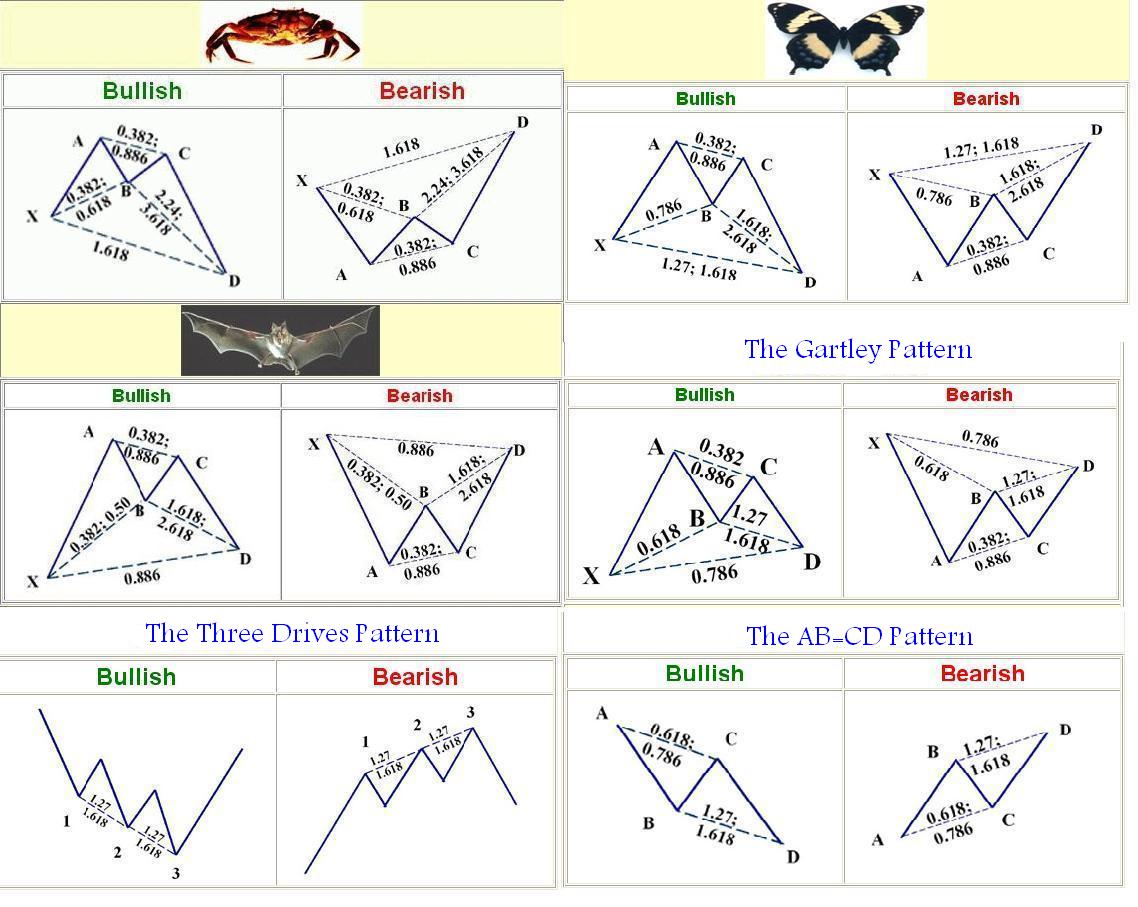
Harmonic trading patterns
Harmonic trading patterns are mathematically based and have different probabilities of success
Source:  http://fib618.wordpress.com/fx-strategy/harmonic-patterns/
  1. AB=CD
  2. Bat
  3. Butterfly
  4. Crab
  5. Gartley
  6. Shark
  7. 50
  8. Three Drives
Each of the above patterns will be analyzed in detail in follow up posts.

Advantages

  • High Probability
With a high success rate, Harmonic trading is increasingly becoming popular with retail traders. As it utilities mathematics and geometry to determine entry and exit points, there is little room for error. It is important however to choose the right pattern and not overtrade. Although there are a number of different setups, the high probability patterns include the Gartley, Crab, Shark and AB=CD.
  • Trend Reversal Forecasting
Another key advantage of Harmonic trading is its trend reversal forecasting capability. In essence, a trader can see whether or not a price movement is at its beginning or end. Once again it is dependent on the choice of harmonic pattern. Traditionally hedge funds that trade on exhaustion (overbought or oversold) situations will use harmonics as one of their many tools to identify reversals.

Disadvantages

  • Complex
Setting up a chart to identify harmonic patterns can be quite complex. As they are based on mathematical and geometrical calculations, a normal trader would not be able to identify a pattern without using an indicator or overlay chart.
  • High Risk
Harmonic Trading can involve significant risk if not managed effectively. As the patterns attempt to identify reversals in a trend, they can sometimes be too early or incorrect. This can lead to the trader betting against the market and momentum. It is always important to impose strict risk and money management rules.
  • Curve Fitting Results – Back test
Hindsight can be a beautiful thing in most cases, however when it relates to harmonics it is not. Curve fitting can occur when back testing harmonic patterns. This is due to the fact that a trade setup may have existed at the time, however the trigger will not show in the back test, as the trend has continued and broken down.
To reduce such risk, it is important to stress test using out of sample data. This can be done by choosing random and specific data ranges, and testing the performance for that period. If the success rate or figures are completely different, then it is curve fitted.

Charting

Following on from our previous comment pertaining to high risk and complex, charting harmonic patterns can be challenging for most traders. It is almost impossible to identify trade setups without using a predefined layover chart or indicator. Remember, timing and execution efficiency are key in harmonic trading, hence the requirement for a mechanised system.
For a harmonic indicator and expert advisor, please contact one step removed.

Risk Management

A common risk management technique to adopt when trading harmonics is the 1 to 2 risk reward. The reason for this choice is the level of risk. Harmonics can be great at picking reversals in price, however when they breakdown, they can be very ugly indeed, and can cause significant losses. Once again an automated system that sets specific stop loss and take profit levels would reduce this risk

Thursday, October 15, 2015

7 Lessons I Learned from 7 Years of Trading by TradingWithRayner

Wednesday, October 14, 2015

The Real Logic And Nature Of Stop Loss Orders

The Real Logic And Nature Of Stop Loss Orders 

A stop loss is not only one of the most important things a trader has to have, but executing it the right way and understanding what a stop loss actually is, is critical for trading success. Misunderstanding the logic behind a stop loss order will be disastrous for a trader. Revenge-trading and moving stop loss orders further away when price goes against you are just two of the trading mistakes triggered by a wrong belief about stops. Those mistakes are often the cause of significant losses for amateur traders and the reason why it is important to take a closer look at the logic and nature of stop loss orders.

The one and only thing that a stop loss order really should be

This is the cause of all problems with stop loss orders. A stop loss order should be placed at a price level where it cancels your trade idea and where your anticipated trade scenario is invalid. This is the one and only reason behind a stop loss order. However, most traders follow a wrong and dangerous process. First, amateurs identify a trade entry, then they look for a potential profit and finally they choose a random stop loss level that allows them to trade with a decent reward:risk ratio and enables them to potentially achieve a certain profit. This could not be more wrong because it shows a complete misunderstanding of the nature of stops. A stop loss order should be placed at a price level where it cancels your trade idea and where your anticipated trade scenario is invalid. Not at random price levels that enable a certain profit.
stop_loss_order
The optimal process of placing a stop loss order

wrong_StopLoss
The wrong approach that most traders follow when it comes to stop loss placement

A trading scenarios and stop loss placement

First, a trader should have a trade idea in his mind and in his trading plan. Then he looks for a price level that would cancel his trade idea. For example, if you want to enter a long trade after a bounce off a double bottom, you have to define how much room you are allowing price to penetrate the double bottom. Below this point, you set your stop loss because it would cancel your trade idea. The screenshot below illustrates the scenario. The green shaded area represents how much you allow price to go against your trade and where you still believe that your trade idea is correct. When price enters the red area, it has moved too far and a buy trade is not the right option anymore because it signals that a bounce off the support and previous low is not a reasonable assumption.
stop_loss
Stop Loss – Valid vs. Invalid trade idea – click to enlarge

Nobody cares about your entry

This point is a continuation of the previous statement. The reason why traders believe that their trade idea is still valid, even if price exceeds their stop loss level is because they overestimate the importance of their entry price. Just because traders don’t want to realize a loss, they hope that price will turn around and go back to their entry. At this point, they are trading completely based on hope and emotions and have completely forgotten about their original trade plan. If your original trade plan was to buy a bounce off support at a previous low, then you should never forget your plan! Never! A price that goes too much against you, signals that your idea is not working out and that support is not holding. If price eventually turns, it has nothing to do with your idea or price support anymore and you should be out by then.

What moving a stop loss means

A common mistake is that traders move stop loss orders further away once price moves against them. However, this means that now price has to move even further so that you can make a profit. Looking at a trade that is going against you from this perspective often makes it much clearer why moving a stop loss further away is such a bad idea. Not only can you now realize a much greater loss, but your trade now has to move much further in order to make any money. The screenshot below illustrates the concept. The trader initially bought at previous support and anticipated a bounce and a price move higher from there. The initial stop loss (1) signaled where his long trade idea would have been invalid. Remind yourself, when price reached his stop loss level, it would have signaled that he does not expect price to go to his take profit order anymore. However, he decided to widen his stop loss order (2). Now, once price keeps going down, the distance between current price and the take profit order increases significantly and although his original trade idea was bullish, the overall chart looks very bearish and a price move all the way to the take profit order is very unlikely and not in line with his original trade idea. The idea is that when price reaches your stop loss level, you don’t expect it to go to your take profit order anymore. Staying in a trade that goes beyond your stop is not based on sound trading principles and a trading plan. Always keep this in mind when engaging with your stop loss order. 
stop3
Stop Loss Widening – What it means for your trade – click to enlarge
Ask yourself the following question before moving a stop loss order: If you were not in the trade already, would you do it all over again with a stop loss at the price you are about to set it to? Most of the time, the answer is no and you are better off by closing the trade and re-evaluating the scenario. Being in a trade often clouds our decision-making process because we are emotionally attached to the trade. Try to avoid such scenarios and always stick to your stop loss order.

What do you want to do next?
Before bear_circle Next
Previous: Take profit and dynamic risk:reward ratio Back to the overview Next: Advanced stop loss